

Journal metadata connects a published article to its authors, journal, version and supporting information. A polished article page can still be difficult to identify when its title, publication date or DOI differs across systems. Checking those details before release gives readers a more dependable route to the work.
This guide describes seven practical checks for journal production teams. It treats metadata validation as part of publication quality, with clear ownership and evidence, rather than a final administrative task. The examples are illustrative workflows; they do not describe a completed audit of any journal or promise a particular search position.
Table of Contents
1. Give journal metadata a dependable source
Begin with an approved article record. Identify which system owns each field and when it becomes final. The submission platform may supply contributor names, production may maintain the publication date, and the hosting platform may generate the public URL. Without agreed ownership, every team can make a locally reasonable change that creates a disagreement elsewhere.
A useful journal production workflow separates author-supplied information from verified publication information. Keep the submitted value, the approved value and the reason for a significant correction where appropriate. This history helps an editor understand whether a name was corrected deliberately or changed during an import. Retain only the information needed for the publishing task.
Create a compact field map showing the source, responsible role and destination of the journal metadata. Include the article page, downloadable files, registration deposit and any partner feed. A field map is particularly helpful when a supplier manages one output and the journal office manages another. It exposes the places where a correction may otherwise stop halfway.
Decide what blocks release. A missing mandatory identifier may require a hold, while an optional descriptive field may be scheduled for improvement. Record that distinction before a deadline arrives. The aim is consistent judgement: teams should know which faults affect identity, access or interpretation and which ones can be corrected safely after publication.
2. Check titles, contributors and affiliations
Compare the approved title against the article page, proof and outgoing record. Preserve meaningful punctuation, mathematical characters and subtitles. Look for truncated text, duplicated prefixes and remnants of production instructions. Journal metadata should describe the article itself; a title field is not a place for promotional terms or unrelated search phrases.
For contributors, compare spelling, sequence and roles with the approved publication information. A name is not merely a display label: it may be used to connect an article with a person’s research record. Check changes with the responsible editorial team rather than guessing from an email address or replacing unfamiliar characters with approximate spellings.
Affiliations need their own review. Distinguish the organisation associated with the research from a current address when the publication records both. Preserve relationships between each contributor and the correct affiliation. A list of accurate institutions can still be misleading if the links between people and institutions are lost during conversion.
Use metadata validation to find empty fields, repeated contributors and character-encoding problems, then ask a person to resolve uncertain meaning. Automated comparison can flag a difference between two strings; it cannot always decide which string is correct. Keep the journal metadata correction attached to the approved source so the next export does not undo it.
3. Verify article identifiers and their destinations
Treat article identifiers as relationships that must work, not just strings that match a pattern. Check the DOI against the approved record and follow its resolved destination. Confirm that it reaches the intended article and version. A syntactically valid identifier pointing to a different page is a serious publication problem.
Distinguish article identifiers from identifiers for the journal, issue, dataset or supplementary object. A production spreadsheet that places every identifier in one unlabeled column invites mistakes. Give each identifier a defined type and purpose, especially when one article refers to several related outputs. Preserve that meaning in the exported record.
Test the destination as a reader would. Check the article title, access route and visible version after following the identifier. If a redirect is involved, confirm that it is intentional and leads to a stable destination. Repeat a representative check after a platform move because the identifier may remain unchanged while the page behind it changes.
Add failure examples to the journal production workflow: the right DOI with the wrong landing page, a supplementary file given the main article’s identifier, and an outdated redirect after migration. Such examples make acceptance criteria concrete. They also help a new staff member understand why article identifiers need more than a format check.
4. Separate publication dates, versions and relationships
A journal may record acceptance, online publication, issue assignment and subsequent correction dates. These events have different meanings. Define each field and compare like with like. Do not replace a first publication date simply because an article is later assigned to an issue, unless the applicable publication policy and data model call for that treatment.
Review how the publication represents versions. Readers should be able to distinguish the current article from an earlier version or a correction notice. Journal metadata should preserve relevant relationships rather than leaving users to infer them from similar titles. Ensure the human-readable page and the exported record communicate a compatible account.
When a correction changes descriptive information, decide which outputs need updating. A title correction may affect the article page, PDF, identifier deposit and partner feeds. Keep a release note that names the changed fields and destinations. This avoids a situation where one public surface is repaired while another continues distributing the previous value.
Scholarly discoverability depends in part on clear identity across time. A reader arriving through an older link needs a usable route to the appropriate publication record. Test that route without assuming the reader knows the journal’s internal version labels. Explain the publication status plainly and use the journal’s established policy for formal notices.
5. Validate the export before depositing it
Run metadata validation on the actual outgoing file, not only on the production database. Mapping rules, escaping and transformations can introduce faults after the source record has passed review. Check required fields, permitted structures and relationships using the relevant destination’s published requirements. Keep a sample of the accepted output for comparison.
Use a small regression set of representative articles. Include a long title, multiple affiliations, special characters, supplementary objects and an article with a correction relationship. The set should represent your journal’s real complexity. A test containing only a simple single-author article may pass while missing the problems that cause repeated production work.
Review warnings in context. An automated tool may identify a missing field without establishing whether it is required for that article type. Assign a person who can decide and record the outcome. Metadata validation is strongest when the system catches repeatable faults and the journal office handles meaning, policy and unusual cases.
Record the export version and the publication record it came from. If a supplier resends a file, ensure everyone can distinguish the replacement from the original. A clear handover reduces uncertainty when a registration service rejects a deposit or a partner reports a mismatch. It also supports a controlled retry instead of several untracked submissions.
6. Inspect the public result after release
Publication is a handover, not the end of journal metadata checking. Inspect the public page and a representative deposited record after release. Compare the title, contributor sequence, identifier and publication date with the approved source. A successful upload message confirms a transaction; it does not prove that every displayed value has the intended meaning.
Follow reader routes that matter to scholarly discoverability. Open the article through its identifier, through the journal’s issue or archive listing, and through a relevant internal link. Check that the publication can be identified without relying on an image or an abbreviated card title. Record the route and the result so another person can reproduce a failure.
Inspect downloadable formats separately. A correct web page does not guarantee that a PDF or other reading format contains the same descriptive information. Check the visible first-page details and any metadata fields that form part of the journal’s delivery requirements. Avoid treating a single export as proof that every output is correct.
Use proportionate sampling for routine releases and expand the checks when a transformation, supplier or platform changes. The journal production workflow should explain why a sample was chosen and which risks remain outside it. Honest evidence is more useful than a blanket statement that every record has been checked when only one landing page was opened.
7. Make corrections part of the journal production workflow
Create a clear route for staff, authors and readers to report journal metadata problems. Ask for the article link, the affected field and the expected information where known. The reporter should not need to understand registration schemas. A simple description such as ‘my affiliation is linked to the wrong author’ can begin a useful investigation.
Repair the approved source before rebuilding downstream records. Otherwise a later export may reintroduce the fault. Track the destinations that received the correction and verify a meaningful sample after propagation. When external processing takes time, distinguish a correction submitted from a correction visibly present in the receiving system.
Review recurring faults by cause: unclear ownership, conversion rules, missing author confirmation or supplier mapping. Improve the process that created the error rather than asking staff to remember another manual workaround. Journal metadata quality becomes more reliable when each correction improves the next release as well as the current article.
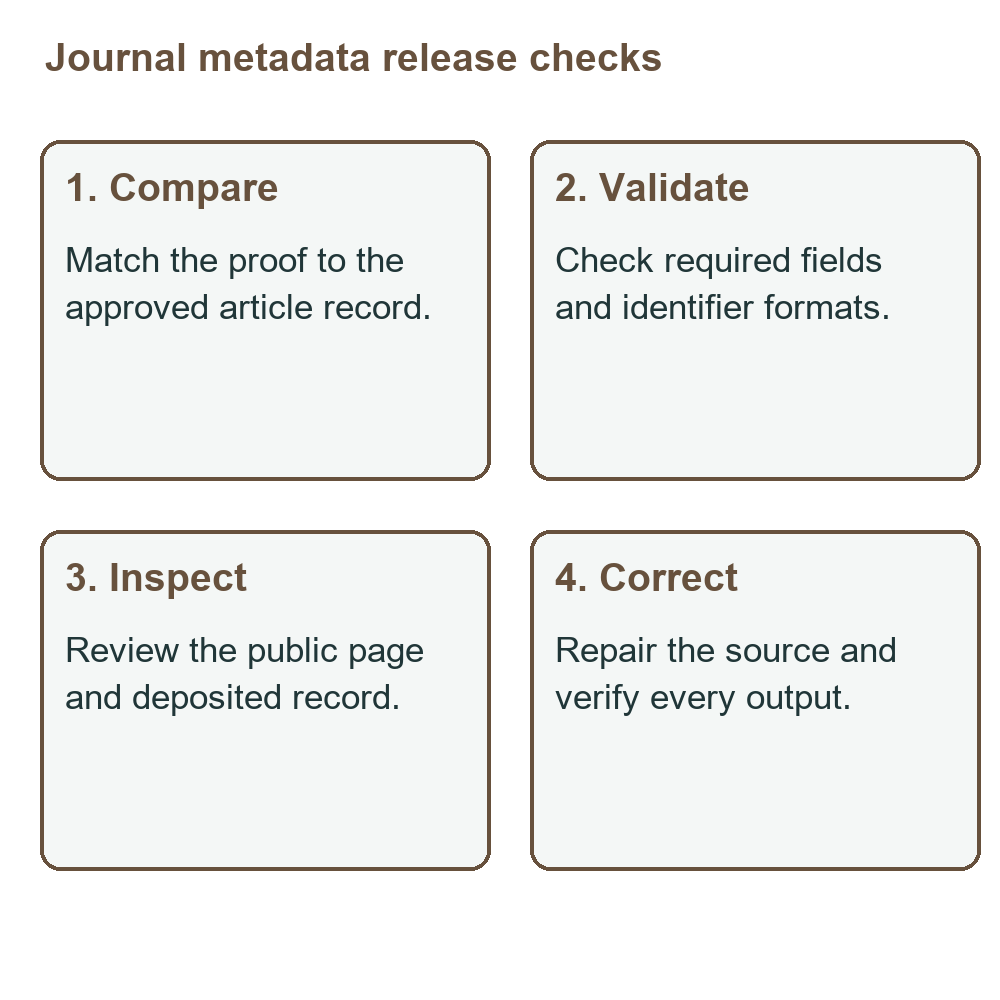
Keep the release checklist short enough to use. Name the owner, the evidence required and the decision for a failed check. A practical checklist combines metadata validation, source comparison and public inspection. It supports scholarly discoverability while acknowledging that discovery systems make their own indexing and ranking decisions.
Worked example: catching a mismatch before an issue goes live
Imagine an issue containing an article with three authors and two affiliations. The proof is correct, but an export joins all affiliations into one text field and assigns the online publication date to an issue-date field. Every required field contains a value, so a simple completeness check reports success.
The production editor compares the outgoing journal metadata with the approved record and notices the lost contributor relationships. The metadata specialist then checks the field mapping and fixes the transformation. The team rebuilds the export and tests it against a second multi-affiliation article to see whether the correction handles the general case.
Before releasing the issue, the editor follows the article identifiers, checks the landing page and compares the deposited record. The release note records which mapping changed, which examples were checked and who approved publication. This record gives the next issue a useful starting point and prevents an individual workaround from becoming the only explanation of the fix.
The example does not require a new publishing platform. It requires agreed sources, a realistic test set and time to inspect the result. These are attainable improvements even when several suppliers share the journal production workflow. A small evidence-based check often provides more confidence than a large unreviewed spreadsheet.
Preparing a useful release record
A release record should identify the issue or article group, the approved source version and the destinations checked. Keep the evidence specific. Instead of writing that metadata was checked, state that contributor relationships were compared with the approved proof, identifiers were followed and the outgoing deposit was inspected. This makes the record useful to someone who did not participate in the release.
Separate a failed check from a pending external update. If a registration service has accepted a correction but its public record has not yet changed, record both facts. This distinction prevents staff from repeatedly resubmitting the same journal metadata or telling an author that the correction is visible before it actually is. Assign a follow-up owner and an appropriate verification point.
Include the scope of sampling. Explain which article types were represented and whether any outputs were outside the review. A small journal might check every new article, while a larger operation may combine automated validation with targeted human review. The important point is that the statement of assurance matches the work performed and that high-risk exceptions receive deliberate attention.
Keep the checklist connected to operational decisions. A failed destination check should identify who can correct the link and who decides whether publication can proceed. A title mismatch should identify the approved source and the person who can resolve uncertainty. Clear decisions make the journal production workflow practical under pressure without reducing quality to a collection of completed boxes.
Review the record after the first few releases. Remove checks that add no useful evidence and strengthen checks that repeatedly expose a meaningful issue. Journal metadata maintenance should be a sustainable process. A concise, well-owned record supports staff handovers, supplier discussions and later corrections much better than a long document created once and never consulted again.
Questions journal teams commonly ask
Can complete journal metadata still be wrong? Yes. Completeness checks find missing values, while source comparison checks whether the values describe the intended article. Use both. A correctly formatted DOI, title and date may belong to different records if an import has shifted a row.
Does better journal metadata guarantee a higher search position? No. Accurate description and reliable links support identification and access, but external services control their own coverage, indexing and ranking. Report verifiable improvements such as corrected identifiers or fewer rejected deposits instead of promising search outcomes.
Who should approve a correction? Use the journal’s existing editorial and production responsibilities. Technical staff can repair a transformation, but a contributor-name or publication-status decision may require editorial confirmation. Assigning authority ahead of time keeps routine maintenance from becoming an ambiguous policy decision.
The takeaway
Reliable journal metadata comes from a repeatable release process: agree the source, verify identity, check the export, inspect the public result and correct every affected destination. Article identifiers and metadata validation work best when people also review meaning and context.
Start with one issue and a representative group of records. Record the mismatches, fix their causes and carry the lessons into the next release. This turns journal metadata from a last-minute formality into a dependable part of publishing quality.
Sources and further reading
Crossref: bibliographic metadata best practices. Guidance on accurately describing publication titles, contributors, dates and identifiers. The workflow examples in this article are illustrative implementation suggestions.
Crossref: metadata principles and practices. A reference for maintaining useful metadata and correcting records. Registration and discovery services remain responsible for their own processing.
Read our related article on preserving editorial history during a peer-review platform migration.
The featured image is an original AI-generated illustrative scene in a photographic style. It represents the workflow discussed here and does not document a particular organisation or event.