
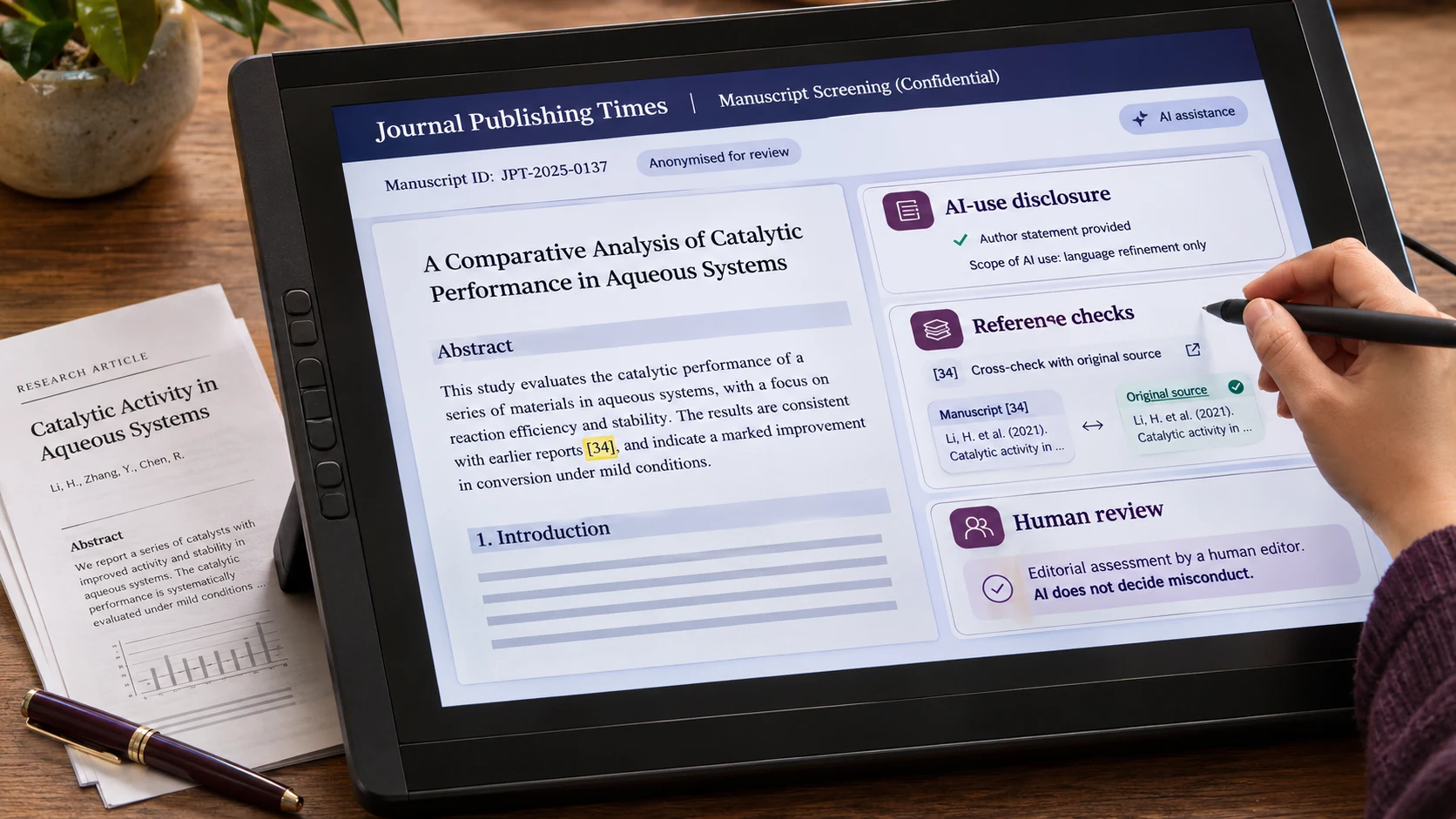
AI manuscript screening should focus on checkable concerns rather than a guess about writing style. These seven checks help journals separate permitted assistance from integrity problems, protect confidential material and record fair editorial decisions.
Generative AI has made it easier to draft, translate, summarize, and revise text. These capabilities can support researchers, but they also create new questions for journal editors. How should a journal respond when a submission appears to contain AI-generated text? Can an automated detector reliably identify such writing? What checks can help editors protect research integrity without unfairly penalizing authors whose language is polished with assistance?
The answer is not to treat every manuscript that sounds machine-written as misconduct. Editorial screening should focus on verifiable concerns, transparent policy, and fair process. AI tools may help identify issues that deserve attention, but they should not replace expert evaluation or become the sole basis for rejecting a submission.
Table of Contents
1. Separate AI manuscript screening from authorship guesses
Authors may use AI tools for language improvement, translation, outlining, or other permitted tasks. The acceptability of these uses depends on journal policy, publisher rules, discipline, and the nature of the work. Using a writing assistant is not equivalent to fabricating data, inventing citations, or concealing a substantive contribution. Journals should state what uses are permitted, what must be disclosed, and who remains accountable for the manuscript.
Policies should also distinguish assistance with wording from the generation of scientific claims, analyses, images, or other research materials. Authors must be responsible for verifying facts, references, interpretations, and any output incorporated into the paper. Where disclosure is required, the journal should explain where and how it should be provided. Clear expectations are fairer and easier to enforce than vague prohibitions.
2. Recognise AI detection limits before making decisions
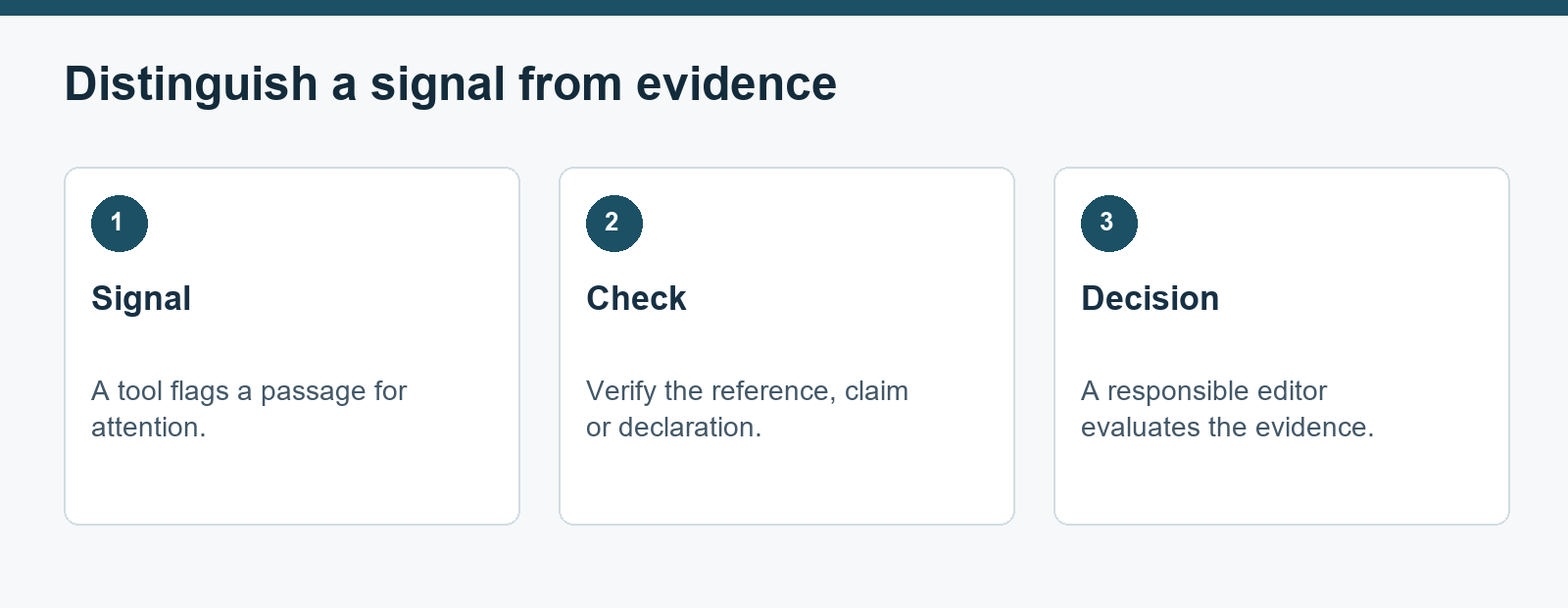
AI-detection tools estimate whether text resembles patterns associated with machine generation. Their results can be affected by editing, translation, short passages, technical language, and changes in generation methods. A detector may flag human-written text or fail to flag generated text. A score should therefore be treated as a signal for further assessment, not proof of authorship or misconduct.
Editors should avoid making adverse decisions from a single detector result. If a concern arises, they can examine the manuscript for specific, checkable problems: references that do not exist, inconsistent methods, contradictory statements, unsupported claims, or unusual irregularities in data or images. The appropriate next step depends on the evidence and the journal’s published policy. Authors should have an opportunity to clarify concerns when the process requires it.
3. Use editorial screening to verify specific concerns
An effective intake process begins with standard checks: required files, author details, ethics statements, conflicts of interest, data availability declarations, and compliance with submission instructions. Automated validation can flag missing information before an editor spends time assessing the manuscript. Scope screening can help identify papers that may not fit the journal, while human review remains responsible for the final decision.
Integrity checks should be evidence-based and proportionate. Editors may verify references, check for duplicated or inconsistent content, review image concerns where relevant, and assess whether methods and results align. AI-assisted tools can help prioritize review, but their outputs should be explainable enough for staff to understand what needs checking. The system should record the concern, the evidence examined, and the decision taken rather than retaining only an opaque risk score.
4. Protect peer review confidentiality and independence
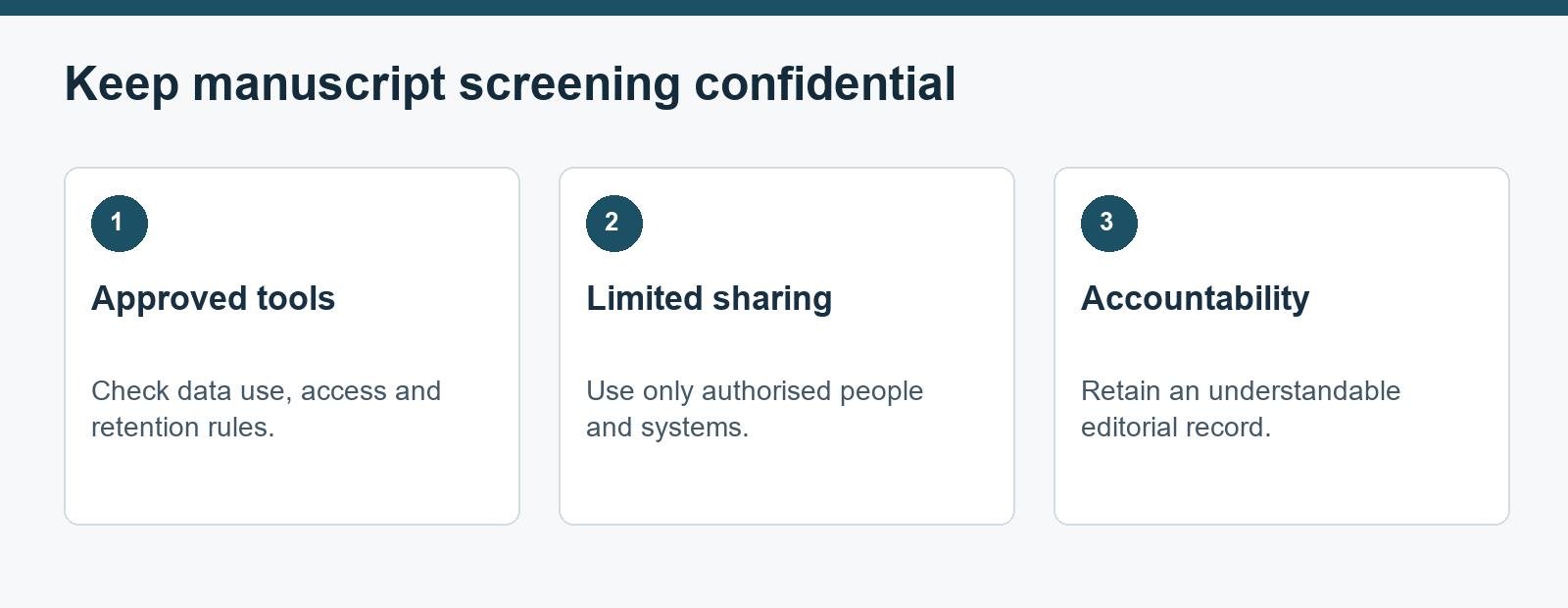
Manuscripts and reviewer reports are often confidential. Editors should not paste unpublished material into public AI services unless the journal’s policies and the service’s terms explicitly permit that use. Journals should assess data retention, access, training use, security controls, and contractual commitments before adopting a tool. Reviewers should receive clear guidance about whether AI assistance is allowed and what information may be shared with external services.
AI should not be used to invent reviewer identities, generate fake reviews, or replace the independent assessment expected from a qualified reviewer. If a tool assists with summarization or language support, the responsible person must check the output and protect confidential information. Editorial accountability remains with the journal and the individuals assigned to make decisions.
5. Make AI manuscript screening policies clear
A useful policy answers practical questions: which AI uses are allowed; which uses must be disclosed; whether AI-generated images, data, or analyses are permitted; what authors are responsible for verifying; how editors and reviewers may use tools; and how confidentiality is protected. The policy should be visible before submission, written in accessible language, and consistent with relevant publisher and ethics guidance.
Journals should define a process for suspected violations. Staff need to know who reviews a concern, what evidence is acceptable, when an author is contacted, how responses are documented, and how appeals or corrections are handled. Consistent procedures help reduce arbitrary decisions and protect both research integrity and author fairness.
6. Record evidence and accountable editorial decisions
A journal management system can organize declarations, check required fields, route flagged submissions to the right editor, record screening outcomes, and track follow-up actions. It can also help distinguish routine administrative issues from concerns requiring specialist review. Workflow rules can ensure that a manuscript does not move forward until required checks are complete, while authorized editors retain control over decisions.
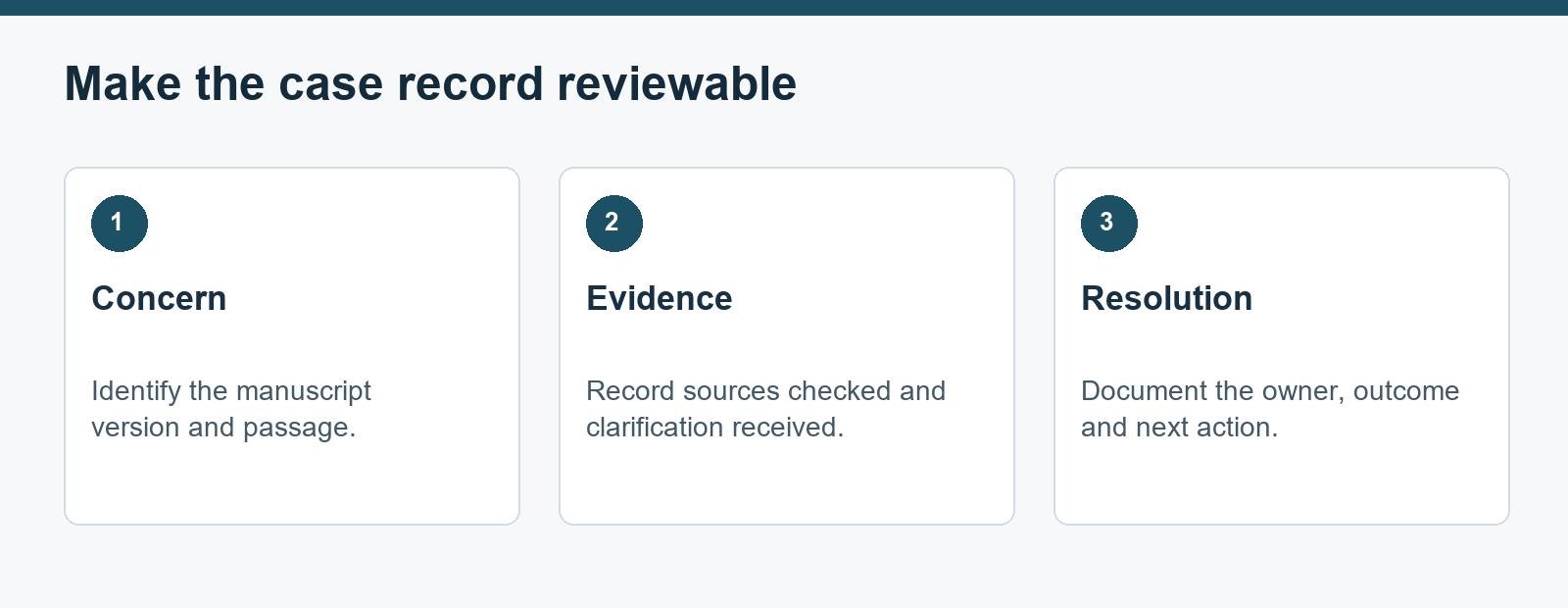
Automation should support, not conceal, editorial reasoning. A useful record includes the issue flagged, the person who reviewed it, the evidence considered, and the resolution.
7. Review AI manuscript screening outcomes for fairness
A screening process should be evaluated over time. Journals can track how often flags are confirmed, how often they are overturned, how long cases remain under review, and whether particular manuscript types are disproportionately flagged. These measures should be interpreted carefully and should not encourage staff to prioritize speed over fairness.
Editors should periodically review sample cases and update procedures when tools or policies change. Authors need a route to correct factual errors in their records or respond to concerns. A process that is transparent, documented, and open to human review is more defensible than one that relies on an unreviewable score.
A worked example: a doubtful reference, not a detector verdict
Imagine an illustrative submission in which a reference cannot be located and a paragraph makes a claim that the cited source does not support. An automated tool also assigns a high probability of generated text. The editor has two checkable reference concerns and one uncertain style-based signal; these should not be combined into a declaration that the author committed misconduct.
The handling editor first checks identifiers, title variations and the relevant source record. A failed search may reflect an incomplete citation, a preprint or a simple transcription error. Where policy calls for clarification, the editor asks for the source and an explanation of the specific claim, using neutral language and retaining the evidence examined.
A qualified person then assesses the response against the journal’s documented procedure. The case record distinguishes a corrected citation, an unresolved unsupported claim and any separate disclosure issue. If specialist advice is needed, access remains limited to authorised people and approved systems.
This example illustrates AI manuscript screening and does not describe an actual author or journal case. Research integrity depends on evidence and fair handling. AI detection limits mean a probability score cannot establish who wrote a passage or whether the underlying research is valid.
An evidence record that supports a fair decision
Retain the manuscript version, the location of the concern, the evidence checked, the responsible editor and the next action. Record what would resolve the concern, including any requested source or explanation. Avoid keeping only a vendor score that another editor cannot interpret or challenge.
Editorial screening should distinguish missing information from evidence of an invalid claim. Peer review confidentiality still applies when a tool is convenient: check the journal’s approved systems and data rules before sharing unpublished text. AI manuscript screening should leave final scientific and editorial judgments with the responsible people.
Our guide to verifiable data-availability checks offers a related example of evidence-based handling. A statement that exists in a form is different from an access route that has been checked, and neither alone establishes the validity of the science.
Common questions about AI manuscript screening
Does polished language prove undisclosed AI use? No. Editing, translation and ordinary writing variation make style an unreliable basis for an authorship verdict.
Should an editor upload a manuscript to a public detector? Follow the journal’s confidentiality rules and approved-tool policy. Do not assume that a freely available service is authorised to receive unpublished material.
What should happen when a flag is wrong? Correct the case record, document the review and use the outcome to improve the screening process. Authors need the clarification or appeal route provided by journal policy.
A practical next step
AI-generated text presents new editorial questions, but it does not remove the need for established principles: accuracy, transparency, confidentiality, fairness, and human accountability. Journals can strengthen screening by using clear policies, layered checks, careful evidence review, and workflow systems that record decisions.
The aim is not to detect every possible use of AI. It is to evaluate manuscripts fairly and protect the integrity of the research record. AI tools can assist that work when their limitations are understood and their outputs remain subject to informed editorial judgment.
Sources and further reading
Wiley: editor FAQs for AI researcher guidelines
Nature Portfolio: artificial intelligence policies
Featured image: an original AI-generated editorial visual created for this article. It illustrates the topic and does not depict a documented organisation or case.